![AI Tinkerers Boston: GTM Agentic AI Launch [AI Tinkerers - Boston]](https://sloppy-joe-app.imgix.net/ai_tinkerers/logos/ai_tinkerers_-_boston_laptop-sticker_190_cd0b73f1c3a32e7ef39fee313d08a52f.png?w=300&fit=max&auto=format%2Ccompress&q=75)





AI Tinkerers Boston: GTM Agentic AI Launch
Register for Event

🤖 Launching the GTM AI Chapter in Boston
AI Tinkerers is expanding. On June 29th, we are launching our GTM AI Chapter in Boston, focusing specifically on the intersection of agentic workflows and go-to-market systems. Following the success of the Seattle community, we are bringing together 150 active builders to dive into the technical architecture of autonomous agents in Marketing and Sales.
This is a room for engineers, researchers, and technical founders who are moving beyond simple chat interfaces. We are moving into the era of persistent system-level operators, autonomous commerce, and self-evolving workflows. If you are building with the latest frontier models like Claude Opus 4.7, GPT-5.5, or DeepSeek V4 to automate complex GTM tasks, this is your community.
Date: Monday, June 29th, 2026
Time: 6:00 PM - 9:00 PM
Location: Boston, MA (Address shared upon acceptance)
Call for Demos: Show the Agentic Stack
We are looking for technical show-and-tell presentations that expose the internals of GTM Agentic AI projects. We want to see the code, the orchestration patterns, and the failure modes.
What we’re looking for:
- Agentic Workflows: Multi-agent systems for lead research, content generation, or sales automation.
- Technical Architecture: How you handle long-horizon tasks, memory systems, and tool-calling.
- Honest Insights: What worked, what broke, and how you solved for reliability in production.
Submit Your Demo Proposal Here
Event Schedule
| Time | Activity | Focus |
|---|---|---|
| 6:00 PM | Doors Open | Networking and Science Fair demonstrations. |
| 6:40 PM | Technical Demos | Live builds and code walkthroughs (5 mins each). |
| 8:15 PM | Deep Dives | Small group discussions on architecture and trade-offs. |
| 9:00 PM | Close |
Who Should Attend
Attendance is strictly limited to 150 active practitioners to maintain a high-signal environment. We screen for builders who can share their stack and implementation details.
- Engineers & Developers: Building autonomous agents or integrating the latest SDKs like Cloudflare’s AI Agents.
- Technical Founders: Shipping GTM-focused AI products with a focus on agentic speed.
- Researchers: Exploring the frontier of long-context reasoning and multimodal performance.
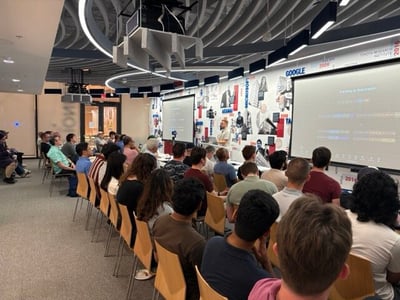
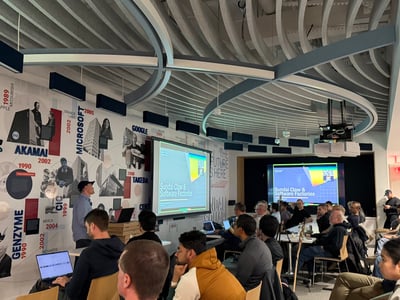
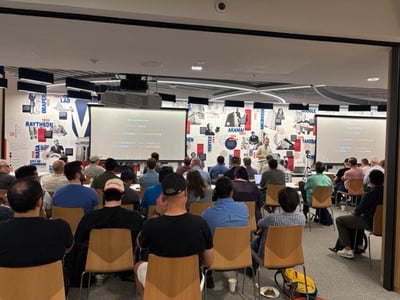
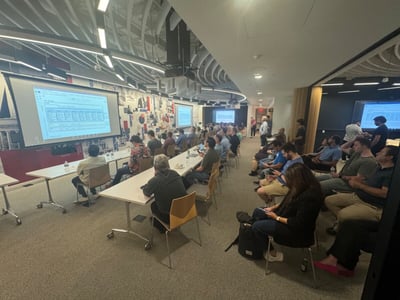
Event photos

Sponsors
We are currently finalizing our host for this launch event. If you are interested in supporting the Boston AI Tinkerers ecosystem, please visit our sponsorship page.
AI Tinkerers Boston Stats
- Attendees: This exclusive community of 2,155 technical professionals features a robust distribution of skills: 82% specialize in advanced AI/ML and Large Language Models, 78% in full-stack software engineering, and 62% in cloud infrastructure and MLOps. Distinguished by a high density of venture founders and researchers from MIT and Harvard, members actively build cutting-edge agentic workflows and medical AI systems.
- Companies Represented: Featuring tech giants like Google, Amazon, Microsoft, and Apple, alongside prominent local innovators such as Red Hat, InterSystems, DataRobot, and Stripe, and emerging startups including ElevenLabs, Quotient AI, Seismiq AI, and Elucid, and more
- Demos: 159 demos have been submitted and 126 have been presented. The most exciting themes have featured agentic automation and orchestration, structured context/state and reliable schema-driven LLM outputs, retrieval and graph-enhanced alternatives to classic RAG, and practical integrations for multimodal/spatial apps. Technical focus has also highlighted vector search optimization, evaluator/quality frameworks, and production-grade deployment with privacy and security considerations.
- Testimonials:
A great demo is one that answers “How did you build this interesting thing?” with visible, reusable mechanics: show the system in action, then zoom in on the parts another builder can copy or avoid. The most effective demos make the agent’s behavior observable (traceability/verification), demonstrate a constrained loop (inputs → agent actions → artifacts → checks → outcome), and include at least one hard-won lesson that reveals what broke, what surprised you, and the tradeoff that mattered. Even if the architecture is complex, it must be presented in a way that gets to the point and stays easy to follow—otherwise ratings fall due to confusion or the sense that the demo never quite delivers the promised payoff. Avoid pitchy or distracting framing (“why should someone use this product?” instead of “what did you build and how?”), avoid skipping critical steps, and avoid leaving the audience without concrete results or a clear justification for the approach.
In Boston, Will Sergeant’s Agentic Trust in the Age of Dangerously Skipping Permissions resonated strongly with the audience, who explicitly said “Traceability is critical!”—a sign that the demo successfully connected to a shared pain point (agents being hard to inspect) and made a security/governance framing feel concrete. In the same city, Rohan Hasabe’s “Review Before Review” — the paradox of fixing code before it hits review earned high marks, and the positive signal (ratings in the 4–5 range) suggests the audience liked seeing how an agentic coding workflow can be improved by enforcing checks “before PR review,” i.e., turning vague code quality goals into something that runs during development. Also in Boston, the demo [“Review Before Review”] approach stands out because it focuses on local, practical integration and real-time feedback rather than abstract claims—this kind of hands-on practicality is exactly what builders respond to. Finally, Bryan Hirsch’s workshop-style Beads primer from Software Factory Intensive workshop received a “Great tutorial!” note even though some feedback said it was unclear why to use it and took too long—showing that when the content is genuinely instructive and operational, the audience will reward it, but they still need the narrative payoff to land quickly.